|
|
|
|
|
In this context, it is important to examine the petroleum supply/demand fundamentals of the world’s largest consumer of oil - the United States:
|
Worldwide Oil supply |
87,500,000 barrels/day |
|
Total US petroleum consumption |
20,680,000 barrels/day |
|
Total US petroleum imports |
12,036,000 barrels/day |
|
Dependence on net petroleum imports |
58.2% |
|
% US oil consumption for transportation |
70% |
|
US Motor Gasoline Consumption |
390,000,000 gallons/day |
Looking at these figures, one can make a logical conclusion:
In order to meaningfully reduce foreign oil consumption, the US must significantly reduce demand from its transportation sector.
US dependence on foreign oil imports has led directly to huge American trade deficits and indirectly to massive American fiscal deficits. US policymakers continue to focus on financial based solutions (bailouts, fiscal stimulus, etc) in an attempt to solve a commodity based problem (oil). This approach has been and will continue to be ineffective. The only way to solve the economic, environmental, and national security problems facing the US due to its dependence on foreign oil imports is adoption of a strategic long-term comprehensive energy policy.
Since 70% of American oil is consumed in the transportation sector, US energy policymakers should first identify which domestically available fuel can reduce vehicle oil demand (gasoline) in an economically viable way. The fuel of choice must be capable of being scaled up over the next 5 years in order to significantly reduce foreign oil imports while doing so an in environmentally friendly manner.
Alternatives to the gasoline powered internal combustion engine existing today are:
Although electric/gasoline powered hybrid vehicles do have higher fuel-efficiency standards, they suffer from a basic problem: they still run on gasoline
EVs in theory are an excellent choice. However, until nuclear or renewable wind and solar infrastructures are built out in order to supply the energy necessary to recharge a significant number of EVs, an energy policy based on adoption of EVs will necessitate increased burning of toxic coal. Despite the percentage growth of the last few years, solar and wind combined still produce less than 3% of US electricity demand – clearly insufficient to recharge a significant number of EVs. Additionally, large scale adoption of EVs would likely trade our foreign oil addiction for an addiction to Asian battery technology. And then there is the range anxiety of EVs. The US should continue to develop and deploy EVs and battery technology, but must be pragmatic about their ability to reduce foreign oil imports in the near term.
Within the next 20-50 years hydrogen will likely be the energy fuel of choice due to its abundance, efficiency, and its cleanliness. Yet hydrogen fuel-cell vehicles are simply not a mature technology today. Nor is hydrogen generation or delivery systems ready today.
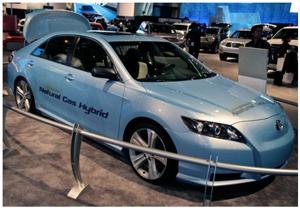 Natural gas vehicles appear to be the best alternative available today. The technology is proven, mature, and can be readily available. The Honda Civic GX has a range of over 200 miles and is currently being refueled in Utah for $0.88/gallon equivalent. That said, the best solution is the electric/natural gas hybrid vehicle Toyota (TM) introduced last year at the LA Auto Show.
This vehicle has the following advantages:
It is clear that NGVs and CNG/electric hybrids are the best vehicles of choice to reduce foreign oil imports.
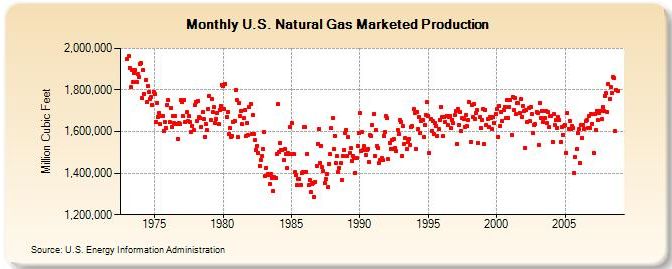
Fortunately the US is blessed with an abundant domestic supply of clean, cheap, and readily available natural gas. Recent discoveries of natural gas in the Marcellus, Barnett, Fayetteville, and Bakken shale formations led to a 9-10% increase in US 2008 natural gas production – the largest rate of increase since 1984. The Haynesville shale alone could well turn out to be one of the largest gas fields in the world.
The figure below shows monthly US natural gas production figures and is significant for two reasons. Note the vertical spike in supply over the last few years as companies successfully drilled into these new shale discoveries and brought large new supplies onto the market. This huge increase in supply has been significant enough to break the historical relationship between oil and natural gas price. While oil today is close to $50/barrel, the glut in natural gas supply has pushed prices below $3.60 per MMBtu.
In addition to lower-48 shale assets, there are huge proven reserves of Alaskan natural gas. Taken together, energy experts now estimate American natural gas reserves are adequate to supply all its home heating, industrial and electrical generation requirements for 60-100 years. If these experts are correct, and recent E&P data indicates they are, this means the US could very easily leverage its natural gas supplies to power cars and trucks in the transportation sector.
From a pricing perspective, today’s low natural gas prices mean many NGV owners are refueling their vehicles at less than half the cost of gasoline. Historically, nat gas has run about 2/3 the price of gasoline. A meaningful shift to natural gas for transportation would significantly increase demand and provide upward pressure on prices. However several recent developments help mitigate these concerns:
Another factor to be considered when considering natural gas prices is long-term oil prices. If worldwide oil supply will not keep pace with worldwide oil demand, the skyrocketing oil prices of 2008 are only a preview of the future. Therefore, natural gas price estimates must be compared directly with future oil price estimates. In this comparison, abundant natural gas supplies win hands down. Even if natural gas prices do rise, the money US consumers would pay to refuel their NGVs would stay in the United States and go to US based energy companies and as royalties to US farmers and landowners. Who should be funded by American energy dollars? Fellow Americans or unfriendly countries like Saudi Arabia, Iran, Iraq, Russia, and Venezuela? This is a no-brainer.
Building a CNG refueling infrastructure would be a significant investment. However, in this day and age of financial bailouts and stimulus packages, why doesn’t it make sense to do so? Like the cross country interstate highway system, or man-on-the-moon projects, a CNG refueling infrastructure would pay dividends to all Americans for decades to come and would pay for itself within 5 years by significantly reducing foreign oil imports. Such an infrastructure build out would provide good jobs, revitalize American companies, and provide much infrastructure that could be reused by a future hydrogen based economy.
One of America’s biggest competitive strengths is its 2.3 million mile natural gas pipeline grid. This grid supplies natural gas to every major metropolitan area in the US. The grid connects 63,000,000 US homes where 130,000,000 cars and trucks could be refueled every night in the garage while their drivers sleep. America’s natural gas reserves combined with her natural gas pipeline grid is the best weapon the US has in the war on foreign oil addiction. Natural gas is the only US domestic fuel that can be scaled up over the next decade to meaningfully reduce foreign oil imports. The US simply needs to make the decision to do so and get it done.
The chart below summarizes the CO2 and particulate emissions of the various fuels.
|
FUEL |
CHEMICAL
COMPOSITION |
CHEMICAL
STRUCTURE |
EMISSIONS |
CO2 EMISSIONS LBS/MILLION BTU |
|
Coal |
60-80% Carbon
5% Hydrogen |
Complex |
Very toxic |
210 |
|
Oil |
C6H14 (hexane) C8H18 (octane) C5H12 to C36H74 |
Complex |
Toxic |
156 (gasoline) 161 (diesel) |
|
Natural Gas |
CH4 (methane) |
Simple |
None |
115 |
|
Hydrogen |
H |
Simplest |
None |
None |
|
Wind/Solar |
N/A |
N/A |
None |
None |
The US burns 390 million gallons of gasoline a day. Each gallon burned combines with oxygen in the air and emits 19 lbs of CO2 into the atmosphere. This means in one year US drivers release 2,704,650 million pounds of CO2 into the Earth’s atmosphere from burning gasoline. In addition to CO2, gasoline emits toxic particulates causing the smog which is visible in so many American cities.
How does natural gas compare? As the chart above shows, natural gas has half the CO2 emissions of coal and 30% less than gasoline. More importantly, natural gas has none (ZERO) of the toxic particulate emissions of coal and oil. It is clear natural gas is environmentally superior to both coal and oil. Environmental “purists” who simply lump natural gas into the “fossil fuels” category are mixing the historical environmental problems (coal and oil) with the 21st century solution (natural gas). Environmental purists who lack the ability to take a pragmatic view of the entire energy problem and support only wind and solar and EVs are shooting themselves in the foot by actually supporting continued short term addiction to oil and coal and the greenhouse gas emissions they spew into the atmosphere!
Natural gas should be the fuel of choice to serve as the backbone of a strategic long-term comprehensive US energy policy:
A Strategic Long-term Comprehensive US Energy Policy
STEP 1: Acknowledge the Problem
STEP 3: Conservation and Energy Efficiency
STEP 4: Transportation Initiatives
STEP 5: Prioritize and Invest in Sustainable Green Energy Sources
STEP 6: Social Initiatives
Investment ideas based on such an energy policy:
Disclosures: The author owns COP.
Related Articles
|
Stock AlertsGet free stock alerts by email: |


Excellent, persuasive article on your favorite topic! NG transportation happens to be important to me also, and that's largely due to some of your recent articles.
I’m frustrated beyond belief that our country is so sluggish to do anything to address the energy noose around our collective necks. We just continue to kick the can down the road. That’s been a 35 year road by my count. Ho-hum. Oil is relatively cheap now. Life is good. We can fill our gas tanks for less than two bucks a gallon. Funny how the sudden price drop makes everything seem so warm and fuzzy. Problem solved, another crisis averted by that trusty American standby -- procrastination.
The need to supplant at least a portion of our oil imports is obvious, as has been successfully argued in your posts many times.
It's hard to believe that NG/CNG is virtually ignored as a motor fuel, for all the reasons you mention. It's a proven technology that we can use NOW! Guys have been doing self-conversions of cars and pickups for over two decades. Local government fleets have proven the technology.
That NG would reduce air pollution is obvious. It's a much cleaner burning fuel, so much so that people somehow find a way to burn it in their kitchens to cook dinner. It's long been known that lubricant oil changes can be extended to the durability limits of the lubricant itself, because it doesn't become contaminated by gasoline combustion byproducts.
I suspect that the main drawback in the minds of many people is along the lines of concerns raised by User283977 in another post, whether " ... we have sufficient natural gas reserves to meet 10, 20, and 30% of transportation demand over the next 20 - 30 years ...".
Another huge concern is the impact on NG supplies and prices. That really needs to be addressed in a convincing way by anybody arguing for using NG as a motor fuel. Many people, especially politicians, would cringe at the thought of burning NG in competition with the mom and her shivering kids who already have a hard time paying for home heating in the dead of winter.
People just need a bit more reassurance on availability of supply and price. Don't get me wrong. I want that Toyota NG-Hybrid today! I believe NG is a viable and immediately available supplement to petroleum distillates for transportation. I look at it this way: political will and popular support were able to push ethanol forward until it became painfully obvious that it was a very bad idea. The US went to ethanol because it's easy. It was easy politically because it immediately appealed to the grain belt states, and it’s easy to produce using old technology, and it blends into the existing fueling infrastructure - except that it must be transporting by trucks, not pipelines. If we can develop ethanol despite its net consumption of more energy than it provides, NG as an intrinsically superior alternative, should be a fairly straightforward sell to the American people.
--R
For investment ideas you forgot to include Westport (WPRT), the maker of heavy duty NG fueled engines for trucks and buses.
The True Rationale of Commodities Supply and Demand
stockology.blogspot.co...
I believe UNG is about at the bottom and it is time to addgressively add positions in UNG.
One flaw in the CNG argument is the 4:1 lower energy density of CNG vs. gasoline. Thus for equal range and energy efficiency, a car powered by CNG would require 4x the tank volume of a gasoline-powered car. I don't know how the Honda GX packages its tank into its body, but I suspect it simply has reduced range and/or trunk space compared to a gasoline-powered version.
The cost of conversion from gasoline to CNG runs $5000 to $7000 per vehicle, and it's hard to believe that this will be economic until the price of gasoline returns to well over $4 per gallon. I drive a Ford Escape hybrid, and I figured I'd break even on the $3000 cost premium after tax credit with gasoline over $2.75 a gallon; made money last summer, not this year. The cost to convert the entire U.S. light vehicle fleet of 240 million vehicles (R.L. Polk) to CNG would be an astronomical $1.5 trillion (doesn't sound so bad in comparison with the projected federal deficit).
Safety is also a concern: a house I used to live in blew up a few years ago because a technician made a wrong connection to a high pressure gas line. Two houses were destroyed here in central Virginia last year when an interstate gas line blew up. The thought of householders plugging their cars into gas lines for overnight refills scares me. But then gasoline is explosive, too, it's just not under pressure. CNG refueling at service stations with trained operators and reliable devices sounds better to me; that's how I get the propane bottle for our grill refilled.
For these reasons, the Pickens Plan dropped the idea of using CNG for light vehicles last year, and is now concentrated on adoption of CNG for heavy trucks. This is supported by the fact that major CNG lines tend to parallel the major interstate truck routes. I have every respect for Boone Pickens and his investment in the cause; he has the good sense to realize the limitations of CNG as a vehicle fuel in the near term.
You suggest a number of policy steps that should be taken, and I can agree with some, particularly slapping an import tax on petroleum. I do not believe that there is an effective government solution to the problem, however; far better to let the market sort out the best among alternative fuels for our future transportation needs.
MadHedgeFundTrader: i agree with most of what you said there except for perhaps one comment: that boone has obama's ear. although boone has apparently (finally) earned a seat at the table, i have yet to once hear obama utter the words "natural gas transportation". further, obama's energy secretary recently said he is "agnostic" about nat gas transportation. you may be right that pickens has obama's ear..whether obama and his administration are listening is i suppose another question.
nrgwatcher: i agree that the "greenies" (as you refer to them) are shooting themselves in the foot because of their lack of pragmatism wrt energy policy. their positions to back solar and wind at the expense of natural gas is, in fact, keeping us addicted to coal and oil and the emissions they spew into the atmosphere. i consider myself an environmentalist, and i fully support solar, wind, and EVs...but a realistic view of the energy challenges posed to the US by peak oil and our 60% dependence on foreign oil and their emissions require some common sense decisions. so, i'll take the nat gas's 20%/50% CO2 reductions over gasoline/coal (respectively) and the lack of particulate emissions. where you and i differ is on peak oil. if you don't believe in peak oil, how do you explain traders putting a $50 price on oil today when inventories are at a 20 year high and we are in the deepest recession since the 30's? in the "old days", oil would be at $8/barrel right now. but they are at $50 and i believe that's because the traders understand peak oil, and they understand that china is snapping up oil reserves all over the world while the US sends all its middle class taxpayer monies to rich bankers, insurance, and financial services executives..
respirate: thanks. and you are right, User283977 sent back some great feedback and i am working on that article right now - hopefully SA will publish it as a companion article to this one. i am having fun with the calculations and it very interesting (at least to me, but i am nat gas OCD). and yeah! i would pay $30k in a NEW YORK SECOND for that toyota electric/nat gas hybrid. i'd buy TWO of em!! hopefully, my next article will address some of your concerns about nat gas supplies and prices - plz look for it and send in more feedback. thanks.
ripskii: yeah, hydrogen is out there in the future, i agree. meantime, i hate to admit it because i used to be anti-nuke, but, looking at the energy projections and our current over-reliance on coal i must admit i agree with you on nuclear. i simply don't see how we can meaningfull deploy EVs without adding more nuclear supply. thanks for pointing out westport - honestly, i wasn't aware of the company but since they fuel trucks and buses, and since most CNG use is in fleets today, you're right, WPRT could be an excellent investment. i need to investigate a bit.
mark anthony: i agree we need more nuclear, although i must plead ignorance when it comes to the technical distinctions between IFR (see ripskiis comment) and the LENR you refer to. perhaps i will start looking into nuclear as, after my next NG article, i am not sure there is much more for me to write about in the nat gas area. thanks for the link, i'll watch it tonite.
rrbatch: thanks for the compliments. i used to support biofuels, but after reading Robert Hefner's book (The GET), i no longer support them. they cause food inflation and use ever more critical water supplies. also, it just doesnt make sense when cheaper and clean nat gas is readily available. regarding your energy density argument, that is why it is CNG (emphasis on compressed). the Civic GX is spec'd for 8 GGE (gas gallon equivalent) at 3600 psi.
you're right about conversion costs, and this is one case where i think gov tax rebates should pick up the tab. it would put alot of people to work in the auto industry, reduce foreign oil imports, and clean up the air - a lot more benefits than these financial bailouts are providing, that's for sure. as far as the total cost to convert, that cost would pay for itself easily in a few years with the reduction in foreign oil and the subsequent money staying in the states by going to american energy and auto companies as well as for nat gas royalties to farmers and landowners. as far as safety, people keep saying that about NG vehicles and my research, with all due respect, shows that it simply is not true that NGVs are more dangerous than gasoline vehicles. you can find disastrous wrecks with each. safety data from california and utah, two states with significant numbers of NGVs do not support the conclusion that NGVs are much more dangerous than gasoline cars and trucks. can u point me to a study that says otherwise? i'd like to read it. i don't think that is why pickens dropped CNG for cars and light trucks, he never supported them in the first place. that is one of the differences i have with pickens, he's always been about fleets and i simply don't see how fleets alone will reduce foreign oil imports to the extent the country needs to do so. as far as the markets sorting out the best alternative - isn't that exactly how we got to our current 60% reliance on foreign oil in the first place? actually i am wrong - the government is subsidizing coal and oil now! why not *change* and support cleaner, abundant, and US produced cheap natural gas for the transportation sector instead? we need to make a big U-turn, on a huge scale, fairly quickly. i simply can't see how this is done without government policy initiatives. otherwise, we simply stay addicted to foreign oil, and we know where that will lead us (i.e. economically it looks alot like where we are today...). thanks.
skirsch.com/politics/g...
Pickens' effort to introduce gas (CNG & LNG)as a transport fuel for trucks and buses depends on Westport to deliver the engines and they are doing it.
No technology is sustainable if it needs constant government support.
And let's stop offending our main oil suppliers: Canada and Mexico. They are NOT supporters of terrorism. They are NOT unfriendly. They are our neighbors and friends.
alex filonov: ok, let's let the market decide: take away the subsidies for coal and oil and let the chips fall where they may! you seem to forget the heavy subsidies that coal and oil are getting now, and have been getting, since the 1970's. add in the oil wars and the cost to secure oil shipments to the US and then where does nat gas stand? answer: a superior US produced fuel. here's the real history: congress, at the advice of exxon at the time, actually prohibited natural gas from new industrial and electrical generation in the late 1970's (!). that is what led to the huge buildout in coal burning electrical generation in the US (which we are now paying a huge environmental cost for). natural gas has taken a backseat to oil and coal ever since in the eyes of the government and governmental policy. i mean, have you actually read EPA regulations wrt NGVs? what a joke. you should consider reading robert hefner's book, The Grand Energy Transition, so you can get the full story. also, i have never offended canada or mexico. i have said that mexico will likely cease to be a significant oil exporter within the next 5 years, and i have stated that i think it is ridiculous to use huge caterpillars to dig oil sands out of the ground, boil it using natural gas and lots of fresh water, only to obtain a low grade crude that needs further refining in order to achieve gasoline when we have natural gas ready to use as is! that is not the market deciding, that is government policy keeping us addicted to oil at any and every cost. it's absurd in my opinion.
CNG is okay for light passenger cars (assuming all the tax breaks and subsidies you indicated for infrastructure), but it can't power aircraft or heavy equipment.
Commercial oil companies, large and small, are plain old fashioned industrial enterprises. They are being shut out and squeezed by governments. Remaining potential exists in abundance, but no one wants to lose billions (again) in Russia.
The one and only cure for peak oil is to get government out of the way, let the market allocate investment. Obviously, that's not going to happen, so you're probably right -- the illogical solution will win.