|
|
|
|
|
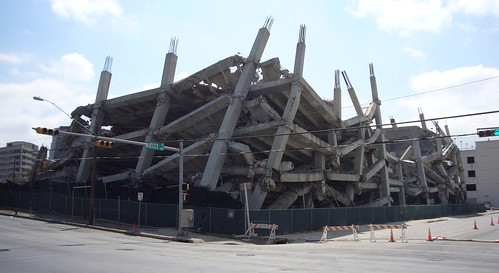
Peak Oil has come and gone rather quietly. Whether you believe oil peaked in 2005 or 2008, we haven't seen the sort of systemic collapse predicted by all sorts of Energy Depletion doomers. Oil Drum editor Gail the Actuary admits as much:
There is a good deal of evidence that we are now a little past "peak oil". Many of us find it doesn't feel quite like we had imagined.
The peak in liquid fuels production seems to have come and gone, but nothing too terrible has happened. The stores are full of food. The price of gasoline is fairly reasonable, compared to a year ago. Here again, I think if we look at our situation in terms of the limits to growth box, it is not just liquid fuels that are important, but a whole group of networked systems, all of which are affected (to varying degrees) by the constraints of the limits to growth box.
I have felt for a long time that energy depletion would manifest itself in a far more subtle, complicated and long term process than that described in novels like World Made by Hand, where the shock of diminishing resources thrusts every economic class in the USA back into a pre-industrial lifestyle in about a decade. Life After the Oil Crash is predicated on such a scenario (assuming we avoid a resource war cum nuclear exchange), selling solar ovens and survivalist gear. Some folks at The Oil Drum have been patiently waiting for the big hurricane that will hamper oil supplies and push us into Post-Peak shock.
Whether impelled by Limits to Growth or Peak Oil, Gail still expects that collapse, or a series of small collapses, is just around the corner:
It is my view that because of this networking, all systems will eventually fail together. A person cannot expect that one system, such as the electrical system, will greatly outlast the other systems. If either the electrical system or the financial system fails, other systems are likely to fail as well.
I see collapse as being stepwise--things may look good for a while, and then there will be a sudden step down. This may happen several times. We are on a step right now.
IMO, small steps of collapse have been happening for years in the poorer corners of the world, like Pakistan, and in the poorer corners of the industrialized world as people slide out of the prosperous middle class into the working poor. The recent financial collapse is an example that some of us will continue to thrive, but the competition in all aspects of life will quietly become more intense and corrupt.


Peak Oil simply means that there is big trouble if demand outstrips declining supply on the upside.
What we have now is partly a recession-driven reduction in demand for oil providing price relief. That might just be a short term relief. But the problem is also complicated by what I might call the artificial factors in oil prices. Those factors fall outside of basic economics theory of supply and demand. In 1973 oil prices shot up not because supply fell or demand jumped up, but because of political factors, OPEC etc.
That is, the real costs of production are quite a bit lower than the market prices, for many producers. Profit margins vary, some oil is cheap to pump, other oil isn't worth pumping now, and then the costs of exploration come in and get effectively amortized in strange ways.
Unless global demand continues to decline, it's inevitable that declining supply will eventually cause major shifts. But look at the "half-life" of the peak, based on the rising edge. It might be measured in decades, not years.
May 3, 2009 7:49 PM | Reply | Permalink
Peak Oil is simply the top of the oil production curve, and what it portends has always been a matter of debate. As I see it, the rapid increase in prices as we approached the peak slowed economic expansion based on cheap energy and initiated the recession that has led to reduced demand.
OPEC has been trying to reduce production among their member states to increase prices, but with limited success. Prices are higher than they were in the 90s, but nowhere near high enough for Matt Simmons to win his bet that oil will average $200/bbl in 2010. We'll see.
http://en.wikipedia.org/wiki/The_Simmons-Tierney_Bet
May 3, 2009 8:39 PM | Reply | Permalink
"As I see it, the rapid increase in prices as we approached the peak slowed economic expansion based on cheap energy and initiated the recession that has led to reduced demand."
I don't know. "approached the peak" -- peak oil production or some other peak?
What rapid increases over which time period? Yes, it's possible that increasing energy prices in 2007 were one factor in setting up the recession. But I'm not clear if you are saying something else.
May 3, 2009 9:39 PM | Reply | Permalink
Yes Peak Oil, of course. What rapid price increases? Do you pay for your own fuel?
May 4, 2009 7:01 AM | Reply | Permalink
I have not owned a car for almost a decade, but I do drive or rent other cars so I follow the price of gas etc.
I take it you were just blowing smoke, since you chose not to be specific about which price rises you think are significant and relevant to my point.
May 4, 2009 1:58 PM | Reply | Permalink
The others were right, you *are* just a troll.
May 4, 2009 3:24 PM | Reply | Permalink
The oil companies (and nations) are playing this cagey. We don't know for sure what's where, how much is left, and who's hiding what.
Still, the crisis I dread will be the water crisis. We can find (or develop) other things to get power, there's only so much water and an ever-increasing supply of people who want it.
May 3, 2009 9:19 PM | Reply | Permalink
With cheap energy things like desalinization, reverse osmosis, piping long distances, purification, etc. all are feasible. But short term droughts can be devastating before infrastructure can be put in place and of course capital costs are generally not negligible. Where in the world do you see the big problems cropping up first?
May 3, 2009 9:47 PM | Reply | Permalink
Where populations are increasing fastest and water supplies are limited. Or in coastal areas that are poor and not well situated for desalination. Those may also be complicated by projected sea level rises, inundating low-lying areas and turning some potential fresh water supplies brackish.
I live in the Upper Midwest. It's pretty much the Saudi Arabia of fresh water. I'm going to be OK well past the point at which I'm projected to live. I would not relish living in the Southwest or over the rapidly drying Oglala aquifer, just to name two places in the United States. And even if the incredibly retrograde social norms there were somehow to evaporate overnight, you could not pay me enough to live on the Arabian Peninsula, to cite someplace overseas. Why? As far as I know, Saudi Arabia is the only country in the world that has no rivers.
May 3, 2009 11:49 PM | Reply | Permalink
Jesus (blesses himself) tell me when you blog, Donal. ha
No sense in pouring water on the fire or being a wet ragamuffin.
But I swear, in the 60's and 70's and 80's we were being told that peak oil production had been achieved.
In some ways, I hope that is finally true. ha
Goooooooooood post as always Donal.
May 4, 2009 1:37 AM | Reply | Permalink
1970/1971 was the peak of US oil production in the lower 48. That was before Prudhoe Bay in Alaska started producing. They're still debating whether the world peak was 2005 vs 2008 since, as Old Grouch notes, Saudi Arabia keeps their output to themselves.
May 4, 2009 7:07 AM | Reply | Permalink
As I learned, post-hurricane, it is possible to live for a prolonged period of time without:
a) power (given a supply of batteries, or candles, and at least a Hibachi with charcoal briquets and matches);
b) transportation (given the fitness required to ride a bicycle or walk);
c) windows and doors (given at least a partial roof that creates an open air pavilion -- although that is no protection against insects and critters).
But it is not possible to live for long without fresh water, whether liquid or ice, period end. Because without it:
1) dehydration obviously occurs in a heartbeat and hygiene goes out the window, which invites illness; and,
2) it is impossible to keep perishable foods, even in a cooler.
That is why people in a disaster area -- where fresh water supplies have been disrupted or become tainted -- become so frantic, and then angry when, for days, FEMA fails to deliver bottled water and ice, and then delivers so little-- even though repairs to the infrastructure may take weeks or months.
Try telling an adult with children that a fair share of water and ice is a gallon jug and one bag of ice for two or three days.... and then add, as a Bush administration FEMA representative did, that "the ration system is being put in place, on purpose, to prevent resale profiteering."
It is a wonder that that official lived to take another breath, much less make another such pronouncement. Nothing like projecting a "free market" mentality onto a populace only interested in basic survival. And then "regulating" that populace, rather than themselves.
May 4, 2009 7:51 AM | Reply | Permalink
It was about 10 years ago that I read that there was an imminent water shortage in the National Geographic.
The aquifers are drying up.
What was even more disturbing to me were the stories of private interests buying up water rights in third world nations. Water rights aren't something that ought to be for sale.
May 4, 2009 8:05 AM | Reply | Permalink
When Limits to Growth was published in 1972 the criticism focused on the models used to predict resource depletion instead of on the fact that nonrenewable resources are, well, nonrenewable. This is not surprising, considering the economies of industrialized and emerging industrialized nations are based on the assumption of limitless growth.
How we manage the backside of the oil curve will IMO determine whether we crash and burn or successfully make the painful but necessary transition to a sustainable economic model. Oil is woven deeply into the fabric of our economic lives (all puns intended), and once consumed, cannot be replaced or recycled.