|
|
|
|
|
Someone once said that to understand the term "expert," one must first understand that an "ex" is a "has been," and a "spurt" is a "drip under pressure." Nowhere is this more evident recently than in describing our so-called economic "exspurts," specifically the shills at the International Energy Agency.
Peak oil
The IEA is the intergovernmental body responsible for monitoring, advising, and reporting to governments on issues of oil supply and demand, pricing, and related policy. Sort of like the "world bank" of oil, their opinions are generally held as gospel by governments around the world. Also like the World Bank, their opinions are often skewed by protection of vested interests and the momentum of tradition.
In practical terms this means that if the IEA and it's "clients" will benefit from telling you that all is "well and good" on the energy front, then that's what they will tell you. Or, if new data is emerging that the IEA has not had to deal with in the past, they will deny its reality until it becomes impossible to ignore through force of events.
That's why Monday's headlines about the IEA had me looking for the joker behind the curtain. The stunner in the Financial Post read, "IEA sees peak oil looming." Now just in case you're about to go back to trimming your toenails or something else really important, bear with me a moment.
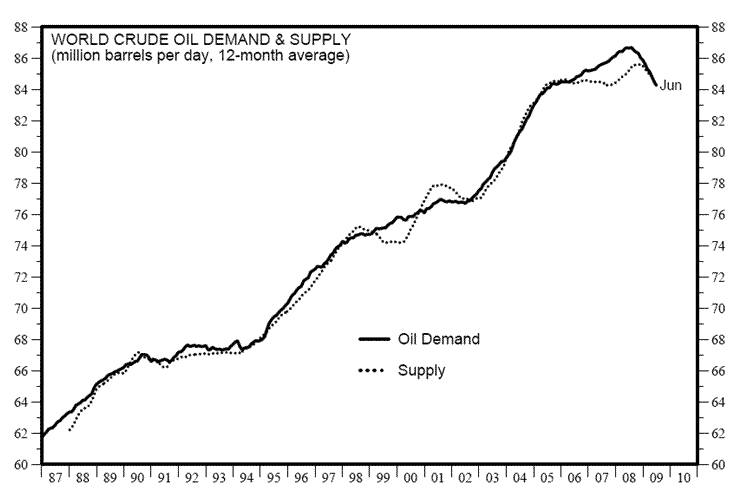
Peak Oil is the name for the point when we can no longer produce enough cheap oil to keep up with global demand. There is still plenty of oil to be extracted, but it is increasingly difficult to find, extract, and refine, and therefore more expensive. And it is precisely this problem that sent the price of oil to $147.00/barrel in July 2008, and sent the global economy into a tailspin.
So why does any of this matter? I'll cut to the chase so you can get back to watching some fictional TV drama like Global News.
While a small but dedicated group of economics geeks like yours truly, were sounding the alarm over the past seven years or so about the impending consequences of peak oil, the IEA and other economic "exspurts" were pumping big dollars into the the PR machines to discredit the "peak oil nuts" and ensure everyone that everything was just fine, thank-you-very-much.
That is, until this past Monday.
On Monday, not only did the gods at IEA admit peak oil "exists," but they stated that the peak of "conventional crude" extraction was in 2006 (it was actually 2005, but how would I know, being merely human). They then went on to make a number of sensational predictions (mostly inaccurate, in my extremely humble opinion) about future oil prices and their impending consequences.
Why the sudden change from ardent protector of the status quo, to prophet of doom? Did the "ex-spurts" at the IEA suddenly get a conscience and decide that the truth (or at least something like it) must rule the day? The skeptic in me tells me that the reason is much more self-serving than that.
If you recall when the last oil price spike occurred, many people blamed the high price of oil on greedy speculators, OPEC officials, over-taxing governments, the pope, indigestion, Kermit the frog, or just about anything other than our global collective addiction to unsustainable levels of energy consumption. By priming consumers in advance about the next price shock, the IEA is hoping to deflect blame from it's "clients" and place it squarely in the category of "acts of God," because really, who could've known?
Well here are a few things I knew. I knew that the price of oil would hit $100/barrel on December 31st, 2007 (yeah, I missed by 2 days; a little slack please). I knew that finance minister Jim Flaherty, was blowing smoke out his backside when he said in 2007 that the Canadian economy wouldn't see a recession. I knew that he was blowing more smoke up yours when he said that the federal government wouldn't go into deficit in 2008. And I knew that while the Bank of Canada was declaring the "recession" over in 2009 that it was really just settling in for an extended stay like that awkward relative we all have. And since talk is cheap, I didn't just say these things but I put my money where my mouth was and radically overhauled my business in preparation for the impending downturn; a move that has paid dividends.
So here are a few more predictions before the IEA steals my thunder. The "recession" is not over because it never was merely a recession. What we are facing is a full-scale global shift in the way we do economics. Resource limits, particularly energy, and more specifically oil, is the new law.
Watch for the price of oil to continue to bounce up and down for a while as the developed world keeps whacking its head on the "economic growth" ceiling. Economic stagnation will keep the price of oil in check for a bit longer, until the rapidly developing Asian nations strain demand beyond the breaking point. Then we will see the price of oil separate from the trend in the stock market as oil rises while western markets flounder under the weight of inflation.
The Canadian dollar will track the price of oil as it increasingly becomes a petrocurrency, which will spell more trouble for Canadian exports. This will continue until the more populated provinces of Ontario and Quebec get upset enough at the concentration of wealth in Alberta to force the feds to do something about it. This will all transpire within the next 5-7 years and then all bets are off.
But predictions just produce hot air and anxiety without some practical advice, and mine is this: Stop looking to distant governments and abstract economics for your wellbeing. The opportunities are right outside your door in the form of localized mutual provision. In English that means develop your skills and trade them within your community. Buy local, source local, employ local, train local, craft local, eat local. Walk more, drive less.
Re-discover the soul enriching value of creative manual labour because this is where our opportunity lies.
And whatever you do, don't call me an "expert." I'm just a human.
Shane Jolley is the former deputy leader of the Green Party of Ontario and co-ordinator of the LocalMotive Project.