|
|
|
|
|
Written by OilEdge
I am somewhat sceptical about ‘Peak Oil’, specifically the notion that there will be a supply-side peak in oil production in this current decade.
Why am I a sceptic? I have four points:
1. There remains considerable scope for further oil discoveries. For example, the Arctic is effectively unexplored and is opening up, and there remain unexplored areas elsewhere, especially in deep water and onshore. Furthermore, the technology-driven successes in exploiting shale gas in the US should now be repeatable in shale oil.
2. Putting new discoveries to one side, globally only circa 10% of existing oil discovered volumes have been brought onto production so there remains a considerable resource to be exploited.
3. Considering fields that are already in production, average global recovery factors are relatively low. Some industry experts place the number as low as 22%, others in the low 30’s. In either case, there is a considerable prize to be won by the use of improved recovery and enhanced recovery techniques. Some numbers illustrate this:
4. Some would argue that ‘Peak Oil’ will occur for economic reasons, specifically because the price of oil will rise so high that it will become too expensive to use.
[I think this is the “The Stone Age didn’t end because of a lack of stones” argument]
This will of course happen if the supply-demand balance remains tight and the cost of exploiting oil resources also rises.
However, neither of these outcomes is pre-ordained, especially in the geo-political cauldron of oil.
The impact of the discovery of large so-called unconventional gas resources in the USA has been to dramatically reduce gas prices in the USA, at the same time potentially removing the need for any imports. And the costs involved are related to the price that oil field service and construction companies can command for their services and products in an open market.
Peak Oil - third peak
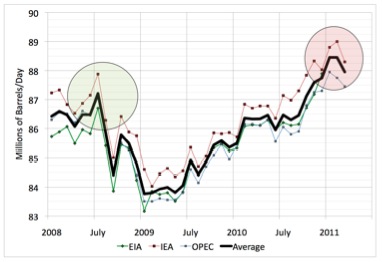
The common thread to these arguments is that technology will enable us to find, develop and produce more oil and continue to lower the cost of doing so. Let’s examine this latter point in a little more detail, as every sustained rise in the price of oil seems to be accompanied by evidence that oil field service companies are able to charge proportionally more for supplying essentially the same service as previously with the result that the cost curve is the same shape as the oil curve, just with a lag.
However, there are technologies ‘out there’ which would dramatically reduce oil companies’ costs, typically in entrepreneurial companies rather than the ‘behemoths’.
Four examples are:
Such breakthroughs – and many others - can dramatically reduce the cost base of finding, developing and producing petroleum…unlike the costly ‘incrementalism’ offered by the big oil field service companies.