

Twelve jackbooted thugs armed with assault rifles stormed the Moscow office of BP (BP).
These goons carried out a ritual search of the company in a show for the media.
To be sure, this raid is just one more example of the fight over limited resources.
You see, just yesterday the Russians gave ExxonMobil (XOM) the rights to explore the Russian Arctic. This is the very same deal they snatched back from BP.
This topic has been well covered in the oil and financial press today.
There is no question that Russia is a mafia state; the BP raid was a show of force as BP is suing its Russian partners in a Siberian court.
This isn't new, either.
Most oil exporting countries have a long history of nationalizing oil fields and reneging on contracts. These include Russia, Bolivia, Mexico, Iran, Burma, Egypt, Argentina, Indonesia, Venezuela, Canada, and Peru.
What makes it interesting to me is that Exxon — the most conservative and successful oil company on earth and America's biggest company — would chose to spend a fortune for rights to explore in one of the planet's most hostile environments...
And why would they select for a partner a criminal organization whom they can't trust?
They Have No Other Choice
They are running out of oil. In the second quarter of this year, the top non-OPEC oil companies turned out fantastic revenue: XOM made $10.7 billion and Shell made $8 billion, while Brent crude was pushing $120 a barrel.
But production declined.
According to Paul Sankey of Deutsche Bank, “Dramatic oil production declines in the second quarter at more than 20 major oil companies, from ExxonMobil (XOM) to Lukoil, were startling, even accounting for lost Libya production of 1.3 million barrels.”
He goes on to reason that oil estimates will have to come down and oil prices could rise to $120 per barrel for the U.S. benchmark contract:
The sudden loss of a major oil producing nation is not a special item, but rather a recurring theme in global oil... in fact Canadians Suncor Energy (SU) and CNQ — declined. Growth hope Brazil’s Petrobras (PBR) — declined. Two of the three biggest Russian oil producers — declined.
Guess what happened in non-quoted Pemex's production in Mexico? Yep, it declined (just 0.6% in fact, but down)...
Fifteen of the top 20 oil companies showed a decline of 11% to 26% in oil production in the second quarter.
I remind you, dear Energy Capitalist, this was during a period when the price of oil spiked.
Traditional economic theory would state that production would increase to meet demand. The opposite happened instead.
CEO of Total is a PO believer
If you need further evidence beyond the production decreases and XOM's risky bet on future reserves, look no further than the CEO of Europe’s third largest energy company, Total.
Mr. Christophe de Margerie told the Financial Times the world will never be able to produce more than 89 million barrels of oil a day:
Christophe de Margerie, Total’s Chief Executive, noted that the economic crisis makes it harder to finance both the production of existing reserves as well as the development of new sources. Citing the high costs of developing Canadian tar sands and political restrictions in Iran and Iraq, he predicts expensive and environmentally challenging projects will continue to be delayed.
Meanwhile older fields in the North Sea will decline in production as their oil becomes more expensive to produce.
The International Energy Agency (IEA) agrees. Three years ago they predicted rates of 130m b/d by 2025. Now they're saying world production will be 100 million b/d by 2030. They also predict global demand will hit 92 million barrels by the end of 2012.
Cry Accord and Tie Up the Dogs of War
Last week, I told you Eni would be the big winner in the Libya endgame.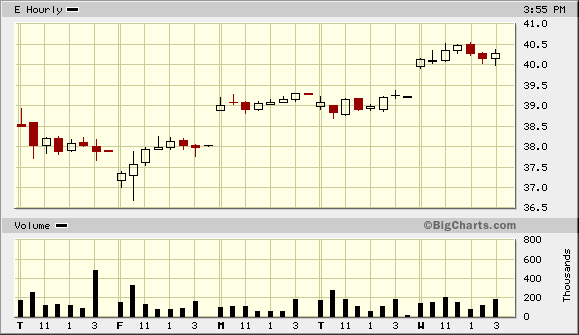
Two days ago, Paolo Scaroni, chief executive officer of Eni (E), signed a deal with rebel leaders to restore the pre-civil war agreements. The deal means Eni will resume gas imports to Italy via the Greenstream pipeline.
Eni is expected to supply Libyan rebels with fuel as part of an international effort to create security and infrastructure in post-Gaddafi Libya...
Expect a tanker to arrive within a week.
The company gets 13% of its revenue from Libya. The stock was up.
To get complete articles and information, join our newsletter for FREE!
All the best,

Christian DeHaemer
Editor, Energy and Capital
From the Desk of Brian Hicks
In July of 2005, Jeff Siegel, Mike Schaefer, Bill Lowe, and I had a conference call with the godfather of Peak Oil, Matt Simmons.
Matt told us he thought the United States was headed for a major energy crisis and predicted the price of oil would reach $300 a barrel...
"Imagine when you can’t afford to fill up your car. I’m not talking about for days... but for weeks. Maybe months. There will be riots."
When we pressed him for a solution, he calmly explained we need to do everything we can to delay the day of reckoning.
And that meant developing alternative and renewable energy as quickly as possible.
After our call, Jeff launched Green Chip Stocks, an investment advisory dedicated to those sectors within the energy complex. It’s been a stunning success, getting his subscribers on the inside of every major solar, wind, battery, and electric car stock before everybody else.
Jeff has become one of the nation’s leading experts in renewable and alternative energy — so much so that he’s sought out by many state and local governments for his views on energy.
Jeff’s latest venture is a once-a-month publication called Modern Energy Monthly in which he analyzes everything under the sun in modern energy.
The first issue is published today. It’s free, and you can read it by clicking on this link.
Profitably yours,

Brian Hicks
www.energyandcapital.com